On-page SEO is the process of optimizing individual web pages to rank higher in search engines and earn more organic traffic. It covers everything from title tags and meta descriptions to content structure, internal linking, page speed, and schema markup. For 2026, on-page SEO also includes optimizing for Google AI Overviews, GEO (Generative Engine Optimization), and semantic search — making it more important than ever to get every element right.
🎬 Watch the full video tutorial: On-Page SEO Checklist for Better Rankings 2026 – Complete SEO Guide
What Is On-Page SEO?
On-page SEO refers to all optimizations made directly on a webpage — the content, HTML source code, and structure — to improve its visibility in search engines. Unlike off-page SEO (backlinks) or technical SEO (crawlability), on-page SEO is entirely within your control and directly influences how Google understands and ranks your content.
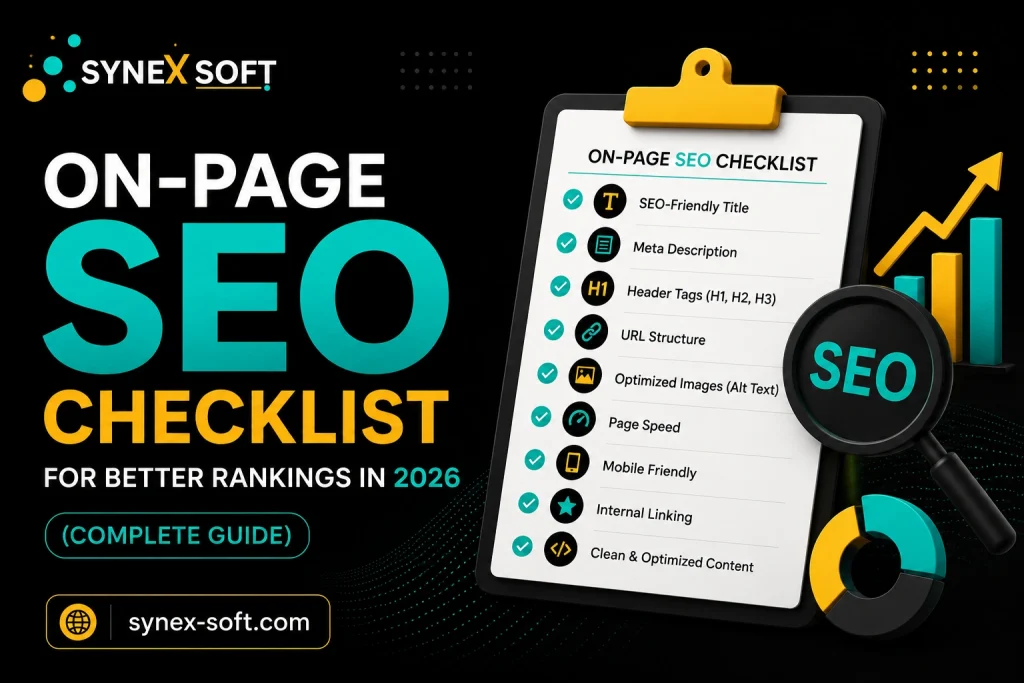
Complete On-Page SEO Checklist for 2026
1. Search Intent Optimization
Before writing a single word, identify the search intent behind your target keyword. Google categorizes intent into four types:
- Informational — the user wants to learn something
- Navigational — the user is looking for a specific website
- Commercial — the user is researching before buying
- Transactional — the user is ready to purchase
Match your content format and depth to the dominant intent. A keyword like “best SEO tools” signals commercial intent — a listicle with comparisons ranks better than a generic definition post. Getting intent wrong means ranking lower, no matter how well the rest of the page is optimized.
2. SEO Title Tag Optimization
Your title tag is the single most visible on-page SEO element. Best practices for 2026:
- Include your primary keyword near the beginning of the title
- Keep it between 50–60 characters to avoid truncation in SERPs
- Add a power word or number (e.g., “Complete Guide,” “2026,” “Checklist”) to improve CTR
- Make it compelling for humans, not just crawlers
- Avoid keyword stuffing — one natural use of the keyword is enough
Example: On-Page SEO Checklist for Better Rankings in 2026 | Complete Guide
3. Meta Description Optimization
Meta descriptions do not directly affect rankings, but they heavily influence click-through rate (CTR), which is a user engagement signal.
- Keep it between 150–160 characters
- Include the primary keyword naturally
- Write a clear value proposition — what will the reader get by clicking?
- Use active language and a soft call-to-action (“Learn how,” “Discover,” “Get the checklist”)
- Avoid duplicate meta descriptions across pages
4. SEO-Friendly URL Structure
A clean URL helps both search engines and users understand your page content immediately.
- Use short, descriptive URLs with the target keyword
- Separate words with hyphens, not underscores
- Avoid dates, IDs, or unnecessary parameters (e.g.,
?p=123) - Keep URLs lowercase and remove stop words where possible
- Example:
/on-page-seo-checklistinstead of/blog/2026/04/15/on-page-seo-checklist-for-better-rankings/
5. Heading Tag Optimization (H1–H6)
Headings give your content a logical hierarchy that helps both users and search engines scan the page.
- Use one H1 per page — it should contain your primary keyword
- Use H2 tags for main sections and H3s for subsections
- Include secondary and LSI (Latent Semantic Indexing) keywords in H2s naturally
- Headings should describe what follows — not just be keyword inserts
- Well-structured headings also improve your chances of earning featured snippets and AI Overview citations
6. Human-First Content
Google’s Helpful Content system rewards content written for people, not for algorithms. In 2026, this means:
- Answer the question clearly and early — don’t bury the lead
- Use simple, concise language appropriate for your audience
- Provide unique insights, data, or expert perspectives — not just rephrased content from other sites
- Structure content so it’s scannable: short paragraphs, bullet points where logical, clear subheadings
- Demonstrate E-E-A-T (Experience, Expertise, Authoritativeness, Trustworthiness) through author bios, citations, and first-hand experience
7. Internal Linking Strategy
Internal links distribute page authority across your site and help Google discover and understand your content structure.
- Link from high-authority pages to pages you want to rank
- Use descriptive, keyword-rich anchor text (avoid “click here”)
- Aim for 3–5 internal links per article to relevant, topically related pages
- Create content clusters — a pillar page supported by related subtopic articles all linking back to it
- Regularly audit for orphan pages (pages with no internal links pointing to them)
8. Image SEO
Images are often an overlooked ranking opportunity.
- Use descriptive file names before uploading (e.g.,
on-page-seo-checklist-2026.jpg, notIMG_1234.jpg) - Write keyword-relevant alt text that accurately describes the image
- Compress images to reduce file size without sacrificing quality — use WebP format where possible
- Add structured data for images if applicable (e.g., product images, recipes)
- Ensure images are included in your image sitemap so Google can index them
9. Page Speed Optimization
Page speed is a confirmed Google ranking factor for both desktop and mobile. Target:
- Core Web Vitals compliance: LCP under 2.5 seconds, INP under 200 milliseconds, CLS under 0.1
- Eliminate render-blocking resources (JavaScript and CSS)
- Enable browser caching and use a CDN
- Minimize HTTP requests and defer non-critical scripts
- Use lazy loading for images and videos
- Test with Google PageSpeed Insights and Search Console’s Core Web Vitals report
10. Schema Markup
Schema markup (structured data) helps search engines understand your content type and enables rich results in SERPs.
- Add Article schema for blog posts and news content
- Use FAQ schema for pages with question-and-answer sections
- Implement HowTo schema for step-by-step guides
- Add Organization and BreadcrumbList schema site-wide
- Validate all schema using Google’s Rich Results Test before publishing
Rich results improve SERP visibility and CTR without directly affecting rankings — but the indirect benefit is significant.
11. AI Search and GEO Optimization
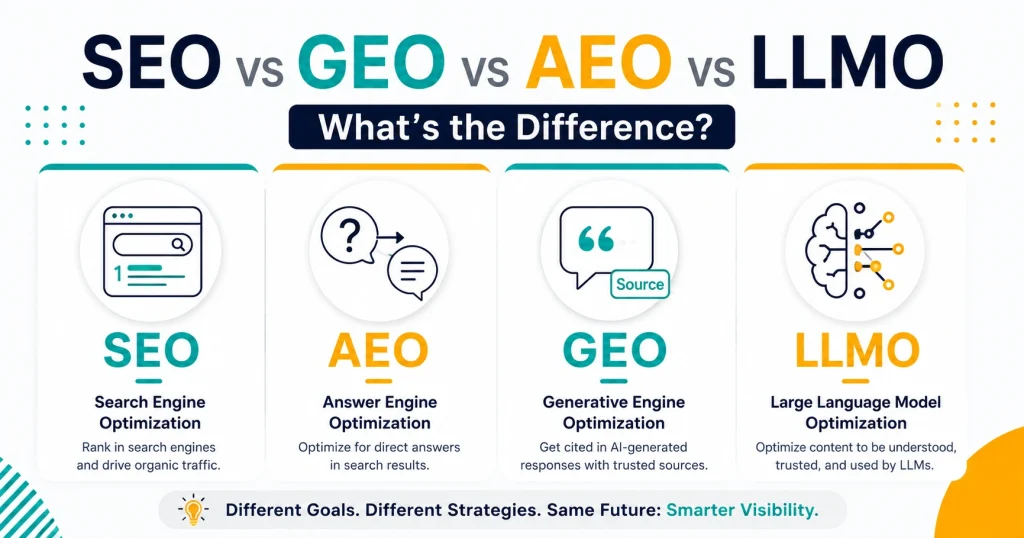
In 2026, optimizing for Google AI Overviews and LLM-based search engines (ChatGPT, Perplexity, Gemini) is a core part of on-page SEO — commonly called GEO (Generative Engine Optimization) or AEO (Answer Engine Optimization).
Key strategies:
- Write direct, factual answers to questions early in the page — AI systems prefer clear, extractable answers
- Use structured content formats: definitions, numbered lists, comparison tables, and FAQ sections
- Cite authoritative sources and data points — AI models favor well-sourced content
- Use semantic SEO: cover the topic comprehensively using related terms, entities, and subtopics rather than just repeating the exact keyword
- Include a dedicated FAQ section targeting long-tail and conversational queries
- Ensure your content is easily parseable — clean HTML, logical heading hierarchy, no excessive JavaScript blocking content
Also Read : What Is SEO and How Does It Work? The Complete 2026 Guide
Final On-Page SEO Checklist (Quick Reference)
| SEO Element | Status |
|---|---|
| Search intent matched | ✔ |
| Primary keyword in title tag (early placement) | ✔ |
| Meta description written (150–160 chars) | ✔ |
| Clean, keyword-rich URL | ✔ |
| One H1 with primary keyword | ✔ |
| H2/H3 structure with secondary keywords | ✔ |
| Human-first, E-E-A-T content | ✔ |
| 3–5 relevant internal links with descriptive anchors | ✔ |
| Image alt text and compressed file sizes | ✔ |
| Core Web Vitals passing | ✔ |
| Schema markup implemented and validated | ✔ |
| FAQ or direct answers for AI/GEO optimization | ✔ |
Watch the Full Video Tutorial
This article covers all the core checkpoints, but seeing them applied step-by-step makes a real difference. Watch the complete walkthrough on YouTube:
▶ On-Page SEO Checklist for Better Rankings 2026 – Complete SEO Guide
Whether you are a blogger, freelancer, affiliate marketer, or SEO professional, applying this checklist consistently will improve your rankings, increase organic click-through rates, and help your content appear in Google AI Overviews and LLM search results.
Published by Synex-Soft | IT Services & Digital Solutions