If you’ve spent any time researching digital marketing trends in 2026, you’ve probably run into four acronyms that get thrown around almost interchangeably: SEO, GEO, AEO, and LLMO. They sound similar. They overlap. And most explanations online only make things more confusing.
Here’s the short version: they are not competing strategies. They’re four layers of the same discipline — getting found, getting answered, and getting trusted, whether the “searcher” is a human on Google or an AI model generating an answer on their behalf.
This guide breaks down exactly what each one means, how they’re different, and how to think about them together as a single 2026 visibility strategy. If you want the bigger-picture context on why this shift is happening in the first place, we’ve also covered that in The Future of SEO: AI Search, GEO, AEO & LLM Optimization — this article is the practical, side-by-side companion to that one.
Why This Comparison Matters Right Now
Search behavior has fundamentally changed. AI Overviews, ChatGPT search, Perplexity, and Gemini are increasingly answering questions directly — without a single click to any website. A page can rank #1 in traditional Google results and still get zero visibility inside an AI-generated answer, because ranking and being cited are no longer the same thing.
That’s exactly why these four terms exist separately. Each one targets a different part of how people (and AI systems) find and consume information today.
What Is SEO? (Search Engine Optimization)
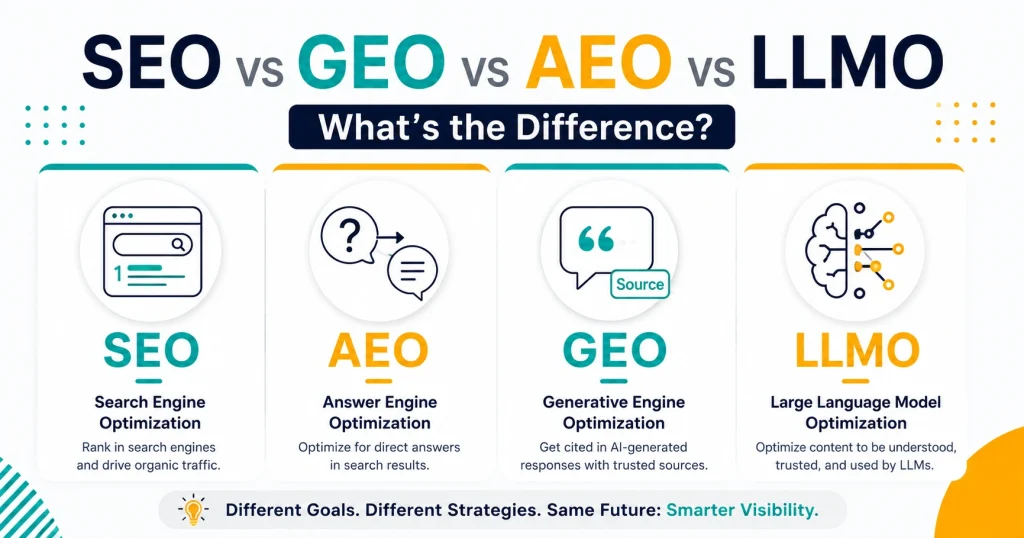
SEO is the foundational discipline: optimizing a website so it ranks higher in traditional search engine results — primarily Google and Bing — driving organic clicks directly to your site.
Core components of SEO include:
- Keyword research and search intent mapping
- On-page optimization — titles, headers, internal content structure
- Technical SEO — site speed, crawlability, indexation, Core Web Vitals
- Off-page authority — backlinks and brand signals
- E-E-A-T — Experience, Expertise, Authoritativeness, and Trust
The traffic model SEO was built on is straightforward: rank → get clicked → visitor lands on your website. If you’re just getting started with the fundamentals, our complete guide to what SEO is and how it works is a good starting point, and our on-page SEO checklist covers the on-site side in detail.
That said — this click-through model is exactly what’s being disrupted by the next three concepts.
What Is AEO? (Answer Engine Optimization)
AEO is the practice of structuring content so it directly answers a specific question — positioning it to be pulled into featured snippets, voice search results, and “People Also Ask” boxes.
When someone asks a voice assistant a direct question, there’s no list of ten links to scroll through. There’s one spoken answer. AEO exists to make sure that answer is drawn from your content.
Common AEO tactics include:
- Structuring content in clear question-and-answer format
- Implementing FAQ schema markup
- Writing concise, extractable answers within the first 1–2 sentences of a section
- Targeting long-tail, conversational search queries
AEO still operates within the traditional search ecosystem — Google’s snippet features and voice assistants tied to search. Think of it as a specialized subset of SEO, purpose-built for “give me the answer right now” search behavior.
What Is GEO? (Generative Engine Optimization)
GEO is where things get genuinely different. GEO means optimizing content so that generative AI systems — Google AI Overviews, Perplexity, ChatGPT search, Gemini — actually cite or reference your content when generating an AI-written answer.
This is a fundamentally different battlefield than classic ranking. You’re no longer competing for positions 1 through 10. You’re competing to be one of a small handful of sources — often just 3 to 5 — that an AI model decides to trust and summarize.
What actually influences GEO performance:
- Clear, well-structured, factual statements that are easy for AI systems to extract
- Original data, statistics, and unique insights — generic, rehashed content tends to get ignored
- Strong topical authority within a specific niche
- Structured data and schema that help AI systems understand context
- Being referenced or mentioned across multiple reputable sources, since generative engines cross-reference
The uncomfortable reality: a page can rank #1 on Google and still be invisible inside an AI Overview if it isn’t structured the way generative models prefer to extract from. This is a big part of why our AI SEO Services exist as a distinct offering from traditional SEO work — the optimization approach genuinely differs.
What Is LLM Optimization (LLMO)?
LLM Optimization is the broadest of the four. It’s the practice of ensuring your brand, data, and content are accurately represented inside large language models themselves — not just within a single AI search result, but across the model’s general knowledge and retrieval behavior.
LLMO covers:
- How ChatGPT, Claude, Gemini, and other models describe your brand when asked about it directly
- Consistency of your business information across your website, directories, review platforms, and social profiles
- Getting mentioned in the kind of high-authority content that feeds into training data and retrieval systems
- Digital PR and brand mentions across the broader web — not just backlinks
A useful gut-check: open any major AI chatbot right now and ask it about your business. Is the answer accurate? Is it even aware you exist? That answer is essentially the scorecard for your current LLMO standing.
SEO vs GEO vs AEO vs LLMO: Side-by-Side Comparison
| Factor | SEO | AEO | GEO | LLMO |
|---|---|---|---|---|
| Primary Goal | Rank in search results | Own the direct answer | Get cited by AI | Be accurately represented across AI models |
| Platform | Google, Bing | Featured snippets, voice search | AI Overviews, Perplexity, ChatGPT search | All LLMs, broad AI ecosystem |
| Success Metric | Rankings, organic traffic | Snippet ownership | Citation frequency | Brand accuracy and mention volume |
| Core Tactic | Keywords, backlinks, technical SEO | Structured Q&A, FAQ schema | Authoritative, extractable, original content | Consistent brand presence everywhere online |
They’re Not Competing — They’re Stacked
The most useful way to think about these four disciplines isn’t “which one should I pick.” It’s a stack:
- SEO is the foundation. Technical health and content quality still matter to every system on this list — including the AI ones.
- AEO and GEO are specialized layers on top of SEO, built for answer-first and AI-generated search behavior.
- LLMO is the umbrella that governs your brand’s overall footprint and accuracy across the entire AI ecosystem.
You don’t choose one. You build solid SEO first, layer in AEO and GEO tactics for the content that matters most, and manage LLMO as an ongoing brand-reputation practice.
Three Steps to Start Optimizing for All Four
1. Audit your existing content for AI extractability. Review your highest-value pages and ask whether an AI system could pull a clean, accurate answer from them. If the content is buried in long, unstructured paragraphs, restructure it. Our technical SEO checklist is a solid starting point for the underlying site health this depends on.
2. Start tracking AI visibility, not just rankings. Search your brand and your core topics inside ChatGPT, Perplexity, and Google’s AI Overviews. Note where you appear — and just as importantly, where you don’t.
3. Prioritize originality over repetition. Unique data, case studies, and proprietary frameworks are what generative engines cite. Content that simply repeats what’s already published elsewhere tends to be filtered out.
Frequently Asked Questions
Is GEO replacing SEO? No. GEO depends on solid SEO fundamentals — technical health, content quality, and authority — to work in the first place. It’s an additional layer, not a replacement.
Do I need to optimize for all four at once? Not immediately. Most businesses should solidify SEO first, then layer in AEO and GEO for their most important content, while treating LLMO as an ongoing background practice rather than a one-time project.
How do I know if my content is being cited by AI? Manually search your target topics and brand name inside tools like ChatGPT, Perplexity, and Google AI Overviews. Dedicated AI-visibility tracking tools are also emerging, but manual checks are a reliable starting point.
Where This Fits Into Your Overall Strategy
SEO, AEO, GEO, and LLMO aren’t four separate marketing budgets — they’re four outcomes of one well-executed content and technical strategy. If your site is technically sound, your content is genuinely original, and your brand information is consistent across the web, you’re already most of the way toward performing well across all four.
For a broader look at where AI search is heading and what it means for your long-term strategy, read The Future of SEO: AI Search, GEO, AEO & LLM Optimization. And if you’d rather have this audited and built out for your specific site, our AI SEO Services team can put together a free strategy audit covering exactly where you stand across SEO, AEO, GEO, and LLMO today.