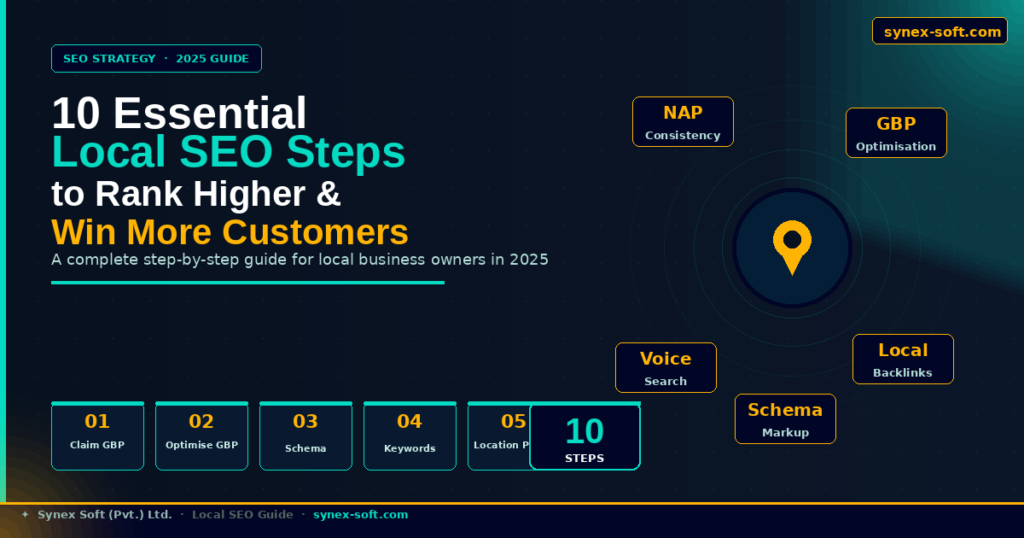
Having a website is no longer enough. If your business relies on customers from a specific area — a city, a district, a neighbourhood — then showing up when those customers search is the difference between a full pipeline and an empty one. Local SEO is the discipline that makes that happen, and in 2025, the businesses executing it well are pulling further ahead of those that are not.
This guide walks you through the 10 essential local SEO steps that consistently move businesses from invisible to dominant in local search results. Each step is practical, sequenced deliberately, and built around how Google’s local ranking algorithm actually works — not how it worked two years ago.
Whether you are starting from scratch or fixing a stalled local SEO strategy, this is your complete 2026 roadmap.
The Foundational Pillars of Local SEO
Before any other work begins, Google needs to trust that your business is real, relevant, and consistent. These first three steps establish that foundation.
Step 1: Claim, Verify, and Fully Set Up Your Google Business Profile
Your Google Business Profile (GBP) — formerly Google My Business — is the single most important asset in local SEO. It is the primary source of information Google uses to determine whether your business appears in the local pack, Google Maps, and the knowledge panel that displays when someone searches your business name.
- Claim and verify your listing. An unclaimed or unverified profile is one of the most common and costly oversights in local SEO. Until you verify ownership, you cannot control the information Google shows about your business — and that information directly affects your local ranking and your customers’ first impression.
- Nail your NAP consistency from the start. NAP stands for Name, Address, and Phone number. These three pieces of information must be identical — character for character — across your GBP, your website, and every online directory where your business appears. Even minor inconsistencies, a slightly different phone number format, an abbreviated street name, a missing suite number, signal to Google that your business information is unreliable. That uncertainty translates directly into lower rankings.
- Choose your business categories with precision. Your primary category is one of the most powerful signals in the local pack ranking algorithm. Choose the category that most accurately describes your core business — not the broadest possible category, and not multiple overlapping ones. Add secondary categories for additional services you provide, but always let your primary category be the one your best customers would most instinctively search.
Step 2: Optimise Your GBP Continuously — Not Just Once
Claiming your profile is step one. Maximising it is an ongoing process that most businesses abandon after the initial setup.
Upload professional, high-quality photos regularly. Profiles with strong photo libraries consistently outperform those without them in both ranking and click-through rate. Include images of your premises, your team, your products or services in action, and your work environment. Update your photo library at least monthly. Where your platform allows it, ensure images carry accurate metadata to reinforce your location signals.
Use Google Posts consistently. Google Posts are short updates — offers, announcements, events, new services — that appear directly on your GBP listing. Businesses that publish posts regularly signal to Google that they are active, engaged, and current. This recency signal matters. Aim for at least two posts per month, tied to something genuinely useful or relevant to your customers.
Build a systematic review generation process. Customer reviews are one of the top three ranking factors in the local pack algorithm. Volume matters. Recency matters. Rating matters. The presence of keywords within review text also carries weight. Most businesses generate reviews passively — waiting for satisfied customers to leave them spontaneously. The businesses that dominate local search make requesting reviews a deliberate, repeatable process: a follow-up message after service, a QR code at the point of sale, a prompt in a post-purchase email. Build the system once, and it compounds over time.
Step 3: Implement Local Schema Markup on Your Website
Schema markup — also called structured data — is code that you add to your website to explicitly communicate key business information to search engines in a format they can read and process without ambiguity.
For local SEO, the most important schema type is LocalBusiness schema. It wraps your business name, address, phone number, opening hours, service area, price range, and aggregate review rating in a structured format that Google can confidently use to populate rich snippets and verify your business details against what your GBP says.
This step is technically invisible to your website visitors, but it is highly visible to search engine crawlers — and it gives Google the confidence to surface your business more prominently in complex, high-intent local searches. It also significantly improves your eligibility for voice search results, which increasingly rely on structured data to populate direct answers.
If you use WordPress, several SEO plugins handle this automatically once configured. If you are on a custom build, your developer will need to add the JSON-LD markup to your relevant pages. Either way, validate your implementation using Google’s Rich Results Test tool after deployment.
On-Site SEO: Turning Your Website Into a Local Search Asset
Your GBP and schema provide external signals. These next steps focus on making your website itself a powerful, location-relevant asset that reinforces those signals and converts the traffic they generate.
Step 4: Conduct Local Keyword Research and Apply It Systematically
Generic keyword research and local keyword research are different disciplines. Broad terms like “plumber” or “accountant” are dominated by national directories and large aggregators that small and medium businesses cannot realistically outrank for generic intent. Local keyword research focuses on the longer, more specific, higher-intent queries that your actual customers use — and that you can realistically rank for.
- Target long-tail local queries. These are phrases that combine a service with a location modifier or a specific intent signal: “emergency plumber available tonight,” “affordable family dentist accepting new patients,” “best Italian restaurant for a business dinner.” These queries are less competitive, more specific, and far more likely to be searched by someone ready to take action rather than someone still browsing at the top of the funnel.
- Map your keywords to specific pages. Each target keyword cluster should have a dedicated page on your website optimised around it — not a single homepage trying to rank for everything. Your homepage covers your primary service and location. Your service pages cover individual offerings. Your location pages (if applicable) cover specific areas you serve. Each page targets a specific cluster of related local keywords without competing with your other pages.
The output of this research should directly inform every other piece of on-site SEO you do — your page titles, your headings, your content, your meta descriptions, and your internal linking structure.
Step 5: Build and Optimise Dedicated Location Pages
If your business operates across multiple areas, or serves customers across a broader region from a single location, dedicated location pages are one of the highest-impact local SEO investments you can make.
A location page is not a thin page with the city name swapped out. It is a genuinely useful, location-specific page that includes your full NAP for that location, a unique description of your services in that area, testimonials or case studies from customers in that region, an embedded Google Map, locally relevant content that would not exist if you simply duplicated another location page, and internal links to your service pages.
Google penalises thin, duplicate location pages — so the effort required to do these properly is also the moat that prevents competitors from easily copying your approach. Done correctly, location pages can put your business in front of local searches across every area you serve, multiplying your local search footprint dramatically.
Step 6: Optimise for Mobile Performance and Core Web Vitals
The majority of local searches now happen on mobile devices. When someone searches for a nearby service, they are almost always doing it on a phone — often while they are out, often when they need something quickly. A website that loads slowly, renders poorly on a small screen, or requires excessive scrolling and pinching to navigate is not just a bad user experience. It is a ranking disadvantage.
Google’s Core Web Vitals — Largest Contentful Paint (LCP), Interaction to Next Paint (INP), and Cumulative Layout Shift (CLS) — are direct ranking signals. Your website needs to pass all three, on mobile, to compete at the top of local search results.
- LCP measures how quickly the largest visible element on the page loads. Target: under 2.5 seconds.
- INP measures how quickly the page responds to user interaction. Target: under 200 milliseconds.
- CLS measures how much the page layout shifts while loading. Target: under 0.1.
Use Google’s PageSpeed Insights tool to benchmark your current scores and identify the specific issues to address. Common fixes include compressing and properly sizing images, deferring non-critical JavaScript, removing unused CSS, and choosing a faster hosting provider.
Step 7: Optimise Your Content and FAQs for Voice Search
Voice search has crossed from novelty to mainstream behaviour. Over half of consumers now use voice-activated search — through phone assistants, smart speakers, and in-car systems — to find local businesses. The queries they speak are structurally different from the queries they type.
Typed query: “Italian restaurant open now” Spoken query: “Hey Google, find me a good Italian restaurant near me that’s open right now”
Voice search queries are longer, more conversational, more specific, and almost always structured as complete questions. Optimising for them requires matching that conversational register in your content — particularly in FAQ sections, which are the most natural format for question-and-answer content that voice assistants draw from.
Build a comprehensive FAQ section on your key pages that answers the real questions your customers ask — not the questions that sound good in a marketing brief. Think about what a customer genuinely wants to know before they contact you: your hours, your pricing range, what your process is, how long things take, what areas you cover, what makes you different. Answer each question in clear, direct, conversational language in 50 to 80 words. This format is ideal for both voice search results and Google’s featured snippet selections.
Off-Site Authority and Ongoing Improvement
The final three steps build the external signals that validate your local authority — and the monitoring habits that ensure your strategy continuously improves.
Step 8: Build Local Citations and Earn Local Backlinks
Local citations are mentions of your business name, address, and phone number on external websites — business directories, industry listing sites, review platforms, and local chamber of commerce websites. Citations are a foundational local SEO signal because they collectively tell Google: this business is real, it is established, and it exists at this location.
The two requirements for citations to help rather than hurt are accuracy and consistency. Every citation must show your NAP exactly as it appears on your GBP and your website. Incorrect or inconsistent citations across directories create conflicting signals that erode Google’s confidence in your business data and lower your local authority. Conduct a citation audit regularly — particularly after any change to your address or phone number — and correct any discrepancies you find.
Local backlinks are a separate but equally important signal. A backlink is a link from another website to yours, and in local SEO, the most valuable backlinks come from websites that are themselves locally relevant — regional news outlets, local business associations, community organisations, industry bodies with a local chapter, or complementary local businesses you have genuine relationships with. A single backlink from a credible local publication is worth more to your local ranking than dozens of generic directory links. Pursue them through genuine community involvement, local sponsorships, guest contributions to local business publications, and by being genuinely useful to the local business ecosystem you operate in.
Step 9: Manage Your Online Reputation Actively
Your reputation is not what you say about yourself. It is what your customers say about you — and how you respond to it. Google watches both signals.
- Review response strategy. Respond to every review — five-star, one-star, and everything in between. For positive reviews, thank the customer and mention the specific service or experience they highlighted (this introduces natural keyword variation into your review responses). For negative reviews, respond calmly, take responsibility where appropriate, offer to resolve the issue offline, and demonstrate that you take feedback seriously. Prospective customers read your responses as much as they read the reviews themselves. A professional, empathetic response to a negative review often does more for conversion than five generic five-star reviews.
- Social media as a local trust signal. Social media is not a direct local search ranking factor — but it contributes to local trust and brand recognition in ways that indirectly support your SEO. An active social presence drives website traffic, generates brand searches (which Google notices), and creates opportunities for your content to reach local audiences organically. Post consistently, engage with local community content, and use social platforms to distribute your blog content and Google Posts.
Step 10: Track, Measure, and Continuously Refine Your Local SEO
Local SEO is not a one-time project. The businesses that consistently dominate local search treat it as a continuous discipline — monitoring performance, identifying what is working, fixing what is not, and adapting to algorithm changes before their competitors do.
- Google Search Console shows you which search queries are driving impressions and clicks to your website, your average position for those queries, and which pages are performing best. Set it up if you have not already, and review it monthly.
- Google Business Profile Insights shows you how customers are finding your profile (direct search vs. discovery search), what actions they are taking (website clicks, calls, direction requests), and how your profile views are trending over time. These metrics tell you whether your GBP optimisation efforts are translating into customer actions.
- Track your local pack ranking. Use a rank tracking tool that separates local pack results from standard organic results — these are distinct positions, and your website may rank differently for each. Track your most important target keywords weekly and watch for correlation between your optimisation activities and ranking changes.
- Set a monthly review cadence. Review your performance data monthly. Identify the two or three actions that will have the most impact in the coming month — a new batch of citations to build, a location page to create, a technical fix to implement, a review campaign to run. This keeps your local SEO strategy compounding rather than stalling.
Conclusion
These 10 local SEO steps are not a checklist you complete once and file away. They are a framework for building and maintaining the kind of local search presence that consistently puts your business in front of customers who are ready to act. Each step reinforces the others: a strong GBP makes your citations more powerful. Consistent NAP data makes your schema markup more trustworthy. A well-optimised website makes your backlinks more valuable. The system works as a whole.
The businesses that execute these steps consistently — not perfectly, but persistently — are the ones that appear in the local pack while their competitors wonder why they are not. Start with Step 1 today. Implement one step per week. In 90 days, you will have built a local SEO foundation that most businesses in your market have never come close to achieving.
If you want to move faster — or if you want an expert team to handle this alongside you while you focus on running your business — Synex Soft’s SEO specialists are here to help. We have helped 200+ businesses across 15 countries build the kind of local and organic search presence that delivers compounding returns. Get in touch for a free audit and we will tell you exactly where you stand and what it will take to change it.
Frequently Asked Questions
Q. What is the single most important step in local SEO?
Your Google Business Profile. A fully verified, completely filled out, and consistently maintained GBP is the foundational requirement for appearing in the local pack. Everything else builds on top of it, but nothing replaces it.
Q. How long does it take to see results from local SEO?
Most businesses start to see measurable improvements within 60 to 90 days of consistently implementing these steps — particularly after achieving NAP consistency, earning initial citations, and accumulating fresh customer reviews. More competitive markets take longer, but the trajectory is always upward with consistent effort.
Q. What is NAP consistency and why does it matter so much?
NAP stands for Name, Address, and Phone number. Google cross-references your business information across your GBP, your website, and every directory where you are listed. Inconsistencies — even minor ones like “St” versus “Street” — create conflicting signals that reduce Google’s confidence in your business data, which directly lowers your local ranking potential. Accuracy and consistency are non-negotiable.
Q. How do I earn quality local backlinks?
Focus on genuinely being part of your local business community. Sponsor local events. Partner with complementary businesses. Write guest articles for local trade publications. Get involved with your local chamber of commerce or business association. Local press mentions from regional news sites are particularly powerful. Quality over quantity always applies — a single link from a credible local source outperforms ten generic directory submissions.
Q. What role does local schema markup play in rankings?
Schema markup tells Google the precise details of your business — your address, hours, services, and ratings — in a structured, unambiguous format. It helps Google confidently surface your business in rich snippets and voice search results, and it reinforces the trustworthiness of your NAP data. It is a technical step that non-technical competitors frequently skip, making it a consistent source of competitive advantage for businesses that implement it correctly.