- AI Search now answers most queries directly, through Google AI Overviews, ChatGPT, Perplexity, and Gemini, without the user clicking through to a website.
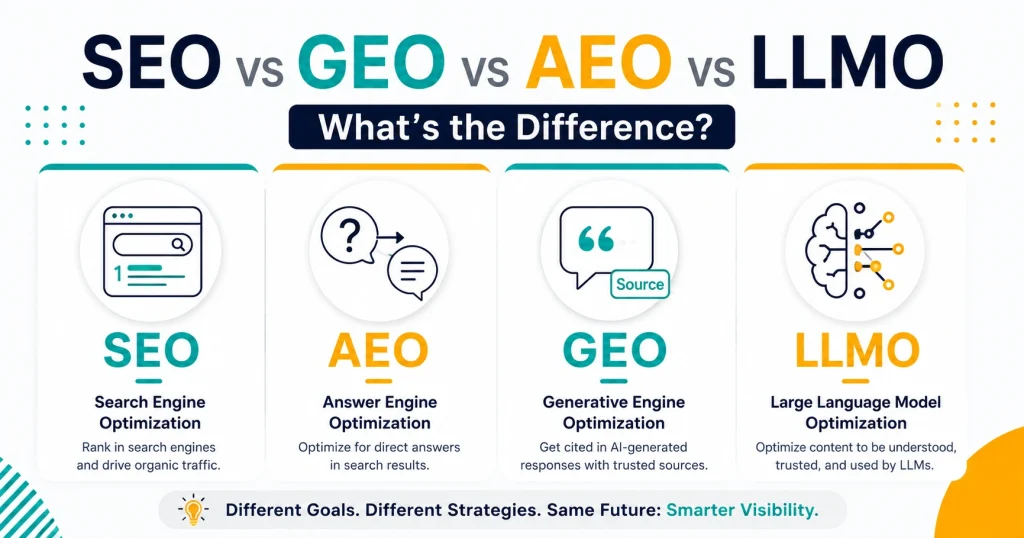
- GEO (Generative Engine Optimization) is the practice of structuring content so it gets cited inside AI-generated answers.
- AEO (Answer Engine Optimization) focuses on winning direct-answer placements: featured snippets, People Also Ask, and voice results.
- LLM Optimization covers the technical side — making a site easy for AI crawlers to read, understand, and reference, including tools like an
llms.txtfile. - Ranking #1 on Google is no longer the finish line. The new goal is to be the source an AI model quotes.
Search Has Already Changed
For over two decades, SEO meant one thing: rank in Google’s top 10 results and let organic clicks flow in. That model is breaking down in 2026.
Search behavior has split across three new channels:
- Google AI Overviews, which place an AI-generated summary above the traditional results, often answering the query before a user scrolls further.
- AI chatbots as search engines — ChatGPT, Perplexity, Gemini, and Claude are now used directly for research, comparisons, and recommendations, bypassing traditional search entirely.
- Conversational, multi-part queries — users type or speak full questions instead of short keyword phrases, expecting a direct, synthesized answer.
The result is a rise in zero-click searches, where the user’s question is answered on the results page or inside a chat interface, with no visit to the source website. For businesses and publishers, this changes the entire objective of SEO: visibility inside an AI-generated answer now matters as much as a top ranking.
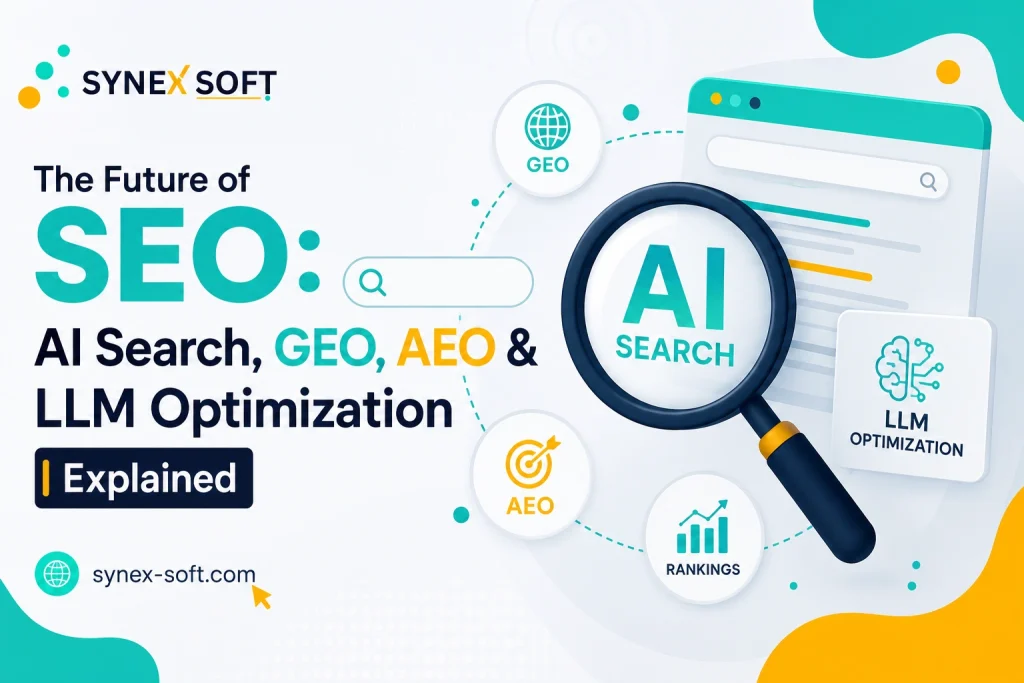
This shift is driving four interconnected disciplines that every website owner needs to understand: AI Search, GEO, AEO, and LLM Optimization.
What Is AI Search?
AI Search refers to the broader shift in how people find information — moving from typing keywords into a search box to asking natural-language questions and receiving synthesized, AI-generated answers. It spans Google’s AI Overviews, AI-powered chat assistants, and voice search, all of which prioritize giving a direct answer over presenting a list of links.
For website owners, AI Search means two things: content needs to be easy for AI systems to extract information from, and it needs to be worth citing — meaning specific, accurate, and not identical to what thousands of other pages already say.
GEO: Generative Engine Optimization
Generative Engine Optimization (GEO) is the practice of optimizing content so that generative AI systems — including Google AI Overviews, ChatGPT, and Perplexity — include it as a source when generating an answer.
GEO differs from traditional SEO in what it prioritizes:
1. Clarity and Structure
AI models parse and summarize content more reliably when it uses clear headings, short paragraphs, and direct statements. Dense, unstructured blocks of text are harder for a model to extract a clean answer from.
2. Specificity and Citability
Generic content rarely gets cited, because a generic explanation already exists on hundreds of other pages. AI models tend to favor content with specific data, original statistics, or unique insight — information that can’t be found interchangeably elsewhere.
For example, a page stating “bagging machines package products efficiently” offers nothing citable. A page stating that “semi-automatic bagging machines typically process 15–20 bags per minute, compared to 40+ bags per minute for fully automatic systems” gives an AI model a concrete, quotable fact.
3. Authority Signals (E-E-A-T)
Experience, Expertise, Authoritativeness, and Trust — the same signals Google has used for years — now inform which sources AI systems treat as reliable enough to cite. Author credentials, original case studies, and transparent sourcing all strengthen this.
AEO: Answer Engine Optimization
Answer Engine Optimization (AEO) is a more specific discipline than GEO. Where GEO is about being included in a broader AI-generated response, AEO is about being the direct answer to a specific question — the kind that appears in featured snippets, People Also Ask boxes, and voice assistant responses.
Three practical pillars drive AEO:
Question-based structure. Use actual user questions as headings (e.g., “How many types of bagging machines are there?”) rather than generic topic labels.
Direct answer first, explanation after. Answer the question in the first two or three sentences beneath the heading, then expand with supporting detail. This format matches what both featured snippets and AI Overviews tend to extract.
Structured data (schema markup). FAQ schema, HowTo schema, and Product schema explicitly tell search engines and AI crawlers what type of content a page contains, making it easier to surface in answer boxes.
Here’s a simplified example of FAQ schema markup:
{
  "@context": "https://schema.org",
  "@type": "FAQPage",
  "mainEntity": [{
    "@type": "Question",
    "name": "What is GEO in SEO?",
    "acceptedAnswer": {
      "@type": "Answer",
      "text": "GEO (Generative Engine Optimization) is the practice of structuring content so AI systems like Google AI Overviews and ChatGPT include it when generating answers."
    }
  }]
}
LLM Optimization: Preparing a Site for AI Models
LLM Optimization is the technical layer beneath GEO and AEO — the work of making a website easy for large language models to crawl, interpret, and reference accurately.
1. An llms.txt file. An emerging standard, similar in spirit to robots.txt, that tells AI crawlers which content on a site is most important and where to find it.
2. Clean, crawlable HTML. Heavy client-side JavaScript rendering can prevent AI crawlers from properly parsing page content. Server-side rendering or static HTML is more reliably read.
3. Structured data beyond FAQs. Organization schema, Author schema, and Product schema give AI models context about who is publishing the content and how trustworthy the source is.
4. Freshness and original research. Both retrieval-based AI tools and periodically retrained models favor recent, original data over recycled information. Publishing original surveys, benchmarks, or case studies increases the likelihood of being cited as a primary source.
It’s worth noting that LLM Optimization is still an evolving field. No technique guarantees inclusion in every AI system, since each platform uses its own crawling, ranking, and retrieval methods. However, the fundamentals — structure, originality, and technical accessibility — apply consistently across platforms.
Practical Checklist: What to Do This Week
- Audit top pages for specificity. Replace generic explanations with original data, statistics, or first-hand insight.
- Add an FAQ section with schema markup to key pages, using real user questions and direct answers.
- Restructure content for scannability — short paragraphs, clear headings, bullet points.
- Create an
llms.txtfile for the site as a forward-looking technical step. - Strengthen E-E-A-T signals — author bios, real case studies, transparent sourcing, testimonials.
- Monitor AI visibility by manually testing target queries in ChatGPT, Perplexity, and Google AI Overviews to see whether the site is being cited.
Frequently Asked Questions
What is the difference between GEO and AEO? GEO is the broader practice of getting content included in AI-generated answers across any generative engine. AEO is more specific — it focuses on winning direct-answer placements like featured snippets and voice search results.
Is traditional SEO still relevant in 2026? Yes. Core fundamentals like technical SEO, page speed, and backlinks still influence visibility. AI Search adds new layers rather than replacing the foundation.
What is an llms.txt file? It’s a plain-text file, similar to robots.txt, that signals to AI crawlers which content on a website is most important to reference.
How do I know if my content is being cited by AI tools? Manually test relevant queries in tools like ChatGPT, Perplexity, and Google AI Overviews, and check whether your site or brand appears in the response.
Conclusion
SEO hasn’t ended — it has split into new, overlapping disciplines. AI Search changed where users look for answers. GEO determines whether a brand’s content gets included in those answers. AEO determines whether it becomes the direct answer. And LLM Optimization ensures the technical foundation lets AI systems read and trust that content in the first place.
Businesses that adapt to all four — rather than treating them as separate trends — will hold the visibility advantage as AI-driven search continues to grow through 2026 and beyond.
Publishing Notes (Synex-soft.com)
- Add the FAQ schema JSON-LD block to the page’s
<head>before publishing, so it’s eligible for rich results. - Use H1 for the title, H2 for each major section (AI Search, GEO, AEO, LLM Optimization, Checklist, FAQ) — this matches the heading structure AI crawlers parse most reliably.
- Consider an
llms.txtfile at the site root if one doesn’t exist yet, listing this article among key pages. - Internal-link this article from any existing SEO/marketing-related pages on Synex-soft.com to reinforce topical authority.