A 30 day SEO plan for a new website is a structured, week-by-week sequence of technical, content, and off-site actions that gets a domain indexed, understood, and eventually cited by both Google and AI search engines. It will not put you in position one in 30 days — no plan can promise that — but it will remove every technical and structural blocker that normally keeps a new domain invisible for months, and it will get you a head start in AI answer engines, which trust new content faster than Google does.
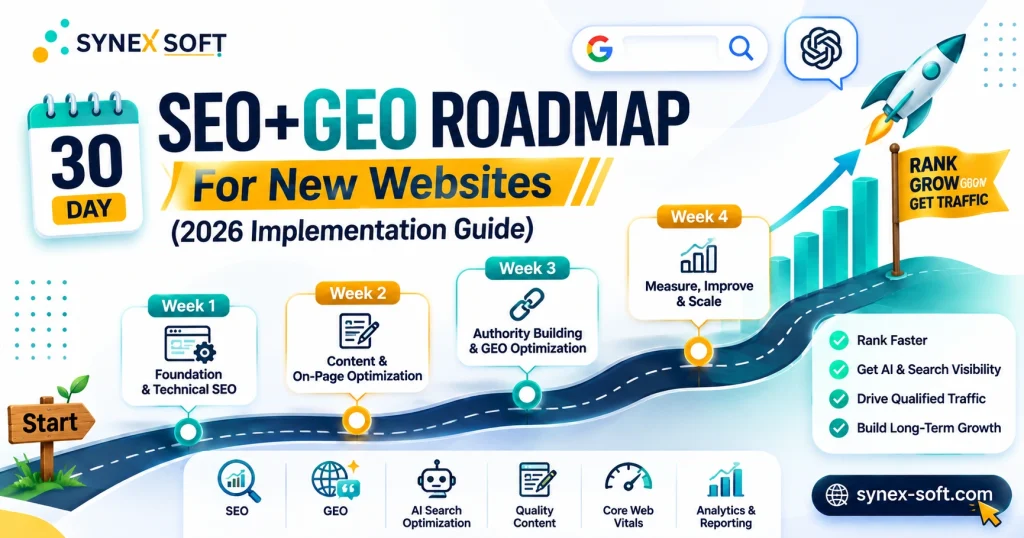
This roadmap is built for anyone who just launched a business site, blog, or project and needs a real sequence to follow instead of scattered tips. It is organized into four weeks: foundation, core content, the GEO layer, and measurement.
Why new websites need a different plan than established ones
A brand-new domain has no crawl history, no backlink profile, and no trust signals yet. Google’s ranking systems lean on age and accumulated authority, which is why new sites sit in what practitioners often call the sandbox period — visible in Search Console, but not yet ranking for competitive terms.
AI search engines behave differently. Tools like ChatGPT, Perplexity, and Google’s AI Overviews pull from whatever content best answers a query at the moment they retrieve it, so a well-structured page on a brand-new domain can get cited within weeks, long before Google would rank the same page on page one. That gap is the reason this roadmap treats SEO and GEO as one connected system instead of two separate projects: the technical and content work you do in weeks 1 and 2 is what makes the GEO work in week 3 possible.
Week 1: Foundation and findability
Before any page can rank or get cited, search engines and AI crawlers have to be able to find the site and read it correctly. A single misconfiguration here — a blocked robots.txt directive, a missing sitemap, a slow-loading homepage — makes the entire site invisible to every engine at once, which wastes everything done in the following weeks.
Core setup checklist:
- Set up Google Search Console and verify the property. This is free and shows exactly which pages are indexed, which are excluded, and why.
- Set up Bing Webmaster Tools. Bing’s index feeds several AI search products, so skipping it limits GEO visibility later, not just Bing rankings.
- Generate an XML sitemap (an SEO plugin can do this automatically) and submit it inside Search Console so Google knows every page exists.
- Audit robots.txt for accidental restrictions that block Google or AI crawlers from reading key pages.
- Confirm the site loads in under three seconds, is fully responsive on mobile, and has HTTPS/SSL enabled — all three are direct or indirect Google ranking factors.
For a complete breakdown of every technical item worth checking in week 1, see our full technical SEO checklist.
Decide what the site should be known for. This is the step most new site owners skip. Search your target audience’s actual questions on Google and on AI platforms like ChatGPT to see which domains are already being cited. That gap — what’s being asked but poorly answered — is where the next three weeks of content work should point.
By the end of week 1, the site should be indexable, technically clean, and pointed at a specific set of questions it intends to own.
Week 2: Building core content that earns trust fast
Page count is not the goal in week 2 — five to ten genuinely excellent pages will outperform a hundred thin ones, because both Google and AI systems reward depth and completeness over volume. Every page built this week should follow four rules.
1. Answer first. State the definition or the direct answer in the first sentence, before any explanation or backstory. This single habit is what both Google’s featured snippets and AI answer engines are built to reward — they extract the first self-contained answer they find.
2. Cover the topic completely. Before writing, review what the top-ranking pages for that query already cover, then add something they missed — a sharper example, a specific number, an angle no one else included. This is what earns a brand-new page trust faster than its domain age would normally allow.
3. Structure for extraction. Clear H2/H3 headings, short paragraphs, lists, comparison tables, and a real FAQ section built from the actual questions people ask. Content that’s easy for a human to scan is exactly what’s easy for an AI system to lift and cite.
4. Add evidence. Specific numbers, named sources, and expert-level detail support every claim. This is one of the strongest levers for both AI citations and human trust — vague, generic claims get skipped by both audiences.
Close out the week by internally linking every new page to related pages on the site, so nothing sits orphaned, and by adding schema markup to each page — it’s the fastest way for machines to understand what a page is actually about. This is also the point at which the site starts building topical authority for a new website: a small cluster of complete, interlinked pages on one subject signals expertise far better than isolated posts on unrelated topics. For the specific on-page elements each page needs, see our on-page SEO checklist.
Week 3: The GEO layer
This is the week most site owners skip entirely, and it’s the one that matters most for generative engine optimization. Everything built in weeks 1 and 2 makes this possible — GEO is not a separate strategy, it’s what happens when well-structured, well-covered content gets picked up by systems that answer questions directly. For the underlying principles behind this shift, see The Future of SEO: AI Search, GEO, AEO & LLM Optimization.
Optimize for AI extraction. On every page, add short, self-contained question-and-answer blocks — a question as the heading, a tight two-to-three sentence answer underneath. AI systems tend to lift this exact format as-is when generating a cited answer, which is the most direct lever available for getting a website cited by ChatGPT, Perplexity, or Google’s AI Overviews.
Build off-site presence deliberately. Both Google and AI systems trust domains that other sites reference. That means genuinely helping people in the communities and forums where the target audience already spends time, and pursuing mentions in relevant directories or “best of” roundup posts — linked or unlinked, both count as trust signals for a GEO strategy for new domains.
Prioritize content freshness. Google ranking still leans heavily on site age and backlink volume, both of which a new domain lacks by definition. AI citation systems weigh recency and structure far more heavily, which is exactly why freshness is the fastest path to visibility for a site that can’t yet compete on backlinks.
Week 4: Measurement and the ongoing refresh loop
Set up measurement first. Write out ten to twenty prompts the target audience would realistically type into an AI system, then test them directly in ChatGPT and Google’s AI Mode. Track where the site gets mentioned and where it gets linked — this is how to track AI search visibility in the absence of a dedicated analytics platform for it.
Check Search Console in parallel, specifically for pages earning impressions on Google’s first or second results page. These are the pages closest to breaking through, and they’re the best return on any additional effort this month.
Run the refresh loop. For any page that’s close to ranking on Google or already getting cited in AI answers but sitting low, find its weak spot and fix it directly — a better answer, an added internal link, an updated date, a missing subtopic. This is a genuine content refresh strategy for SEO, not a one-time task: repeat it on a schedule until the page consistently performs.
By the end of day 30, the site has a working system, not just a stack of published pages: findable by search engines, structured for AI extraction, and running on a measurement loop that keeps improving instead of going stale.
Frequently asked questions
How long does it take for a new website to rank on Google? Most new domains need several months to a year to rank for competitive terms, largely due to Google’s trust-building process for unproven sites. AI search engines don’t have the same delay — a well-structured page can start getting cited within weeks of publishing, which is why this roadmap treats GEO as the faster near-term win while Google rankings build in parallel.
Do I need a large content budget to follow this roadmap? No. Five to ten thoroughly researched pages in week 2 outperform a large volume of thin content, both for ranking and for AI citation. The roadmap is built around depth and structure, not publishing volume.
Is GEO a replacement for SEO? No. GEO depends on the same technical foundation and content quality that SEO requires — a page that isn’t indexable or well-structured won’t get cited by AI systems either. They’re sequential layers of the same system, not competing strategies.
What’s the single highest-leverage task in this roadmap? Structuring content with self-contained, answer-first sections in week 2 and week 3. It’s the one habit that pays off across Google’s featured snippets, AI Overviews, and third-party AI answer engines simultaneously.
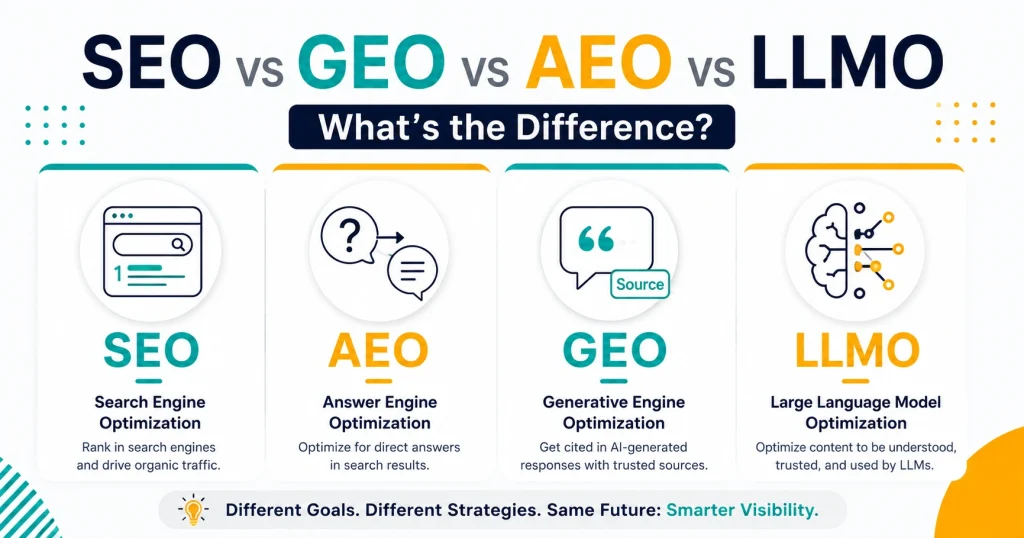
*This roadmap focuses on implementation — a day-by-day sequence of actions. For a deeper breakdown of how SEO, GEO, AEO, and LLM optimization differ conceptually, see SEO vs GEO vs AEO vs LLM Optimization: What’s the Difference?; for the underlying principles behind ranking in AI Overviews and LLM answers, see The Future of SEO: AI Search, GEO, AEO & LLM Optimization. For the fundamentals this roadmap builds on, start with What Is SEO and How Does It Work?